
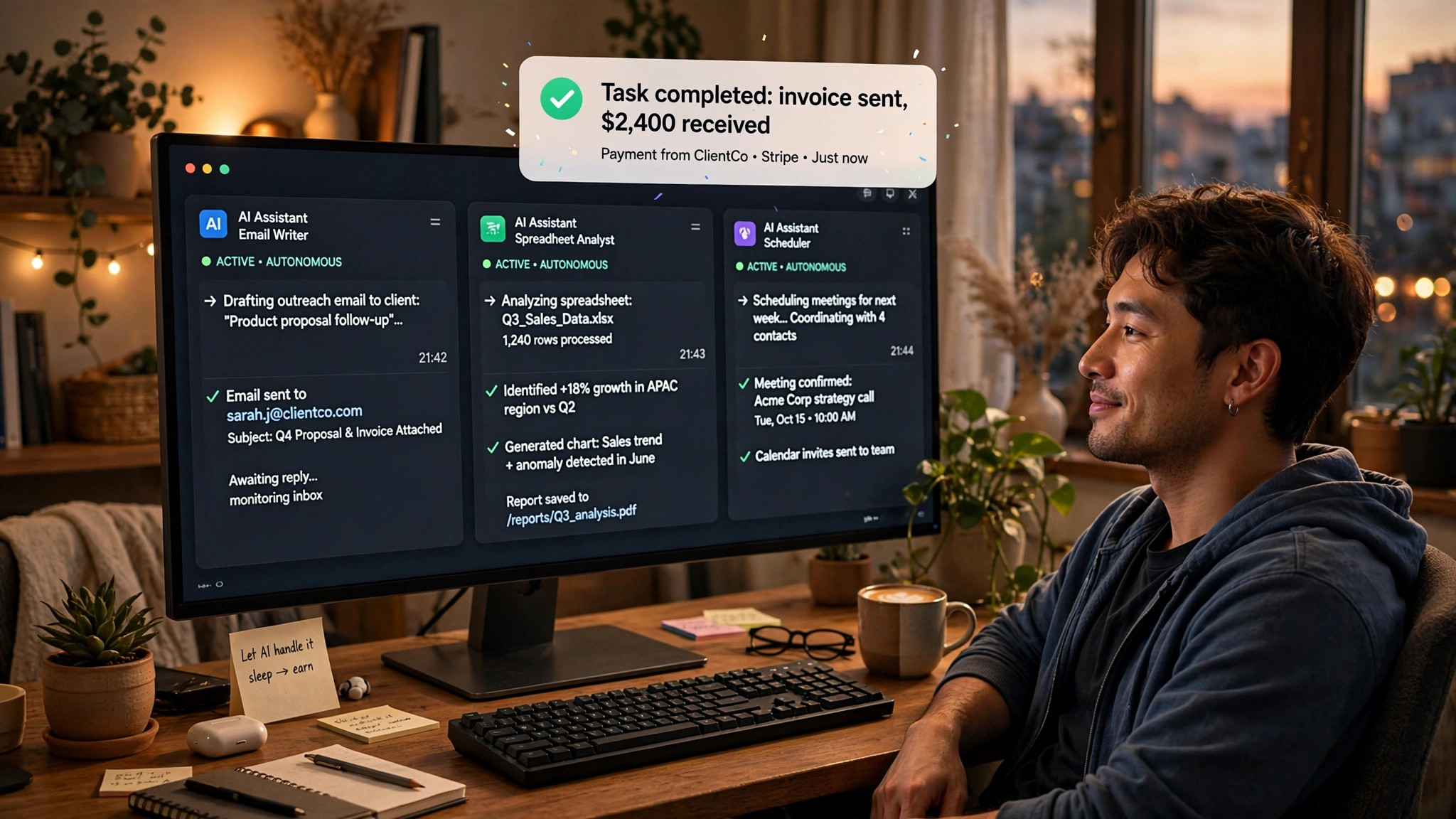
How to Make Money with AI Agents in 2026: 7 Realistic Ways
SkillQuesters contains affiliate links. If you purchase through them, we may earn a commission at no extra cost to you. Everyone says AI agents will make money while you sleep. We spent time reading real experiments — including people who gave an agent $0 and watched for 72 hours — to separate what actually works…
SkillQuesters contains affiliate links. If you purchase through them, we may earn a commission at no extra cost to you.
Everyone says AI agents will make money while you sleep. We spent time reading real experiments — including people who gave an agent $0 and watched for 72 hours — to separate what actually works from the hype. Here’s the honest picture.
The short version: fully autonomous agents earning money with zero human involvement mostly fail. In one documented 72-hour experiment, an agent did everything right — published software, bid on jobs, delivered a bounty — and earned $0.00. In another, it took 19 days and 2,000+ commits before a stranger paid $19.
But there’s a second story underneath: people using AI agents as leverage are making real money. The agents don’t replace the human — they multiply them. These 7 ways reflect that reality.
Why “agent does everything” usually earns $0
Two honest experiments explain the wall:
- Trust is the bottleneck. A brand-new agent account with zero reviews loses every freelance bid to established sellers. Distribution takes months, not hours.
- Money needs a verified human. Every legal way to receive payment ends at the same two requirements: a verified identity and a bank-linked account. An agent has neither — so the human stays in the loop by design.
The winning pattern is therefore: you (a real person) own the accounts and the audience; agents do the production. Everything below follows that pattern.
7 realistic ways to earn with AI agents
1. AI automation services for local businesses
The most proven model: find a painful, repetitive task in a small business and automate it. Real examples: missed calls after hours, slow quote responses, no-shows for appointments. Businesses lose 10–30% of incoming calls — an agent that answers 24/7 closes that hole.
You don’t need to code: no-code tools like n8n (free self-hosted) connect AI to calendars, CRMs, and messaging apps. Typical pricing in the market: a setup fee plus a monthly retainer.
Realistic income: $500–$2,000/month per client once you have proof.
2. Content production at scale
Agents are genuinely great at one thing: research, draft, format, repeat. Creators run content pipelines where agents produce drafts and a human approves. One documented case: content agents generating the equivalent of 100+ posts per week.
This works for blogs, newsletters, and social accounts — but the money comes from what the content promotes (affiliate links, products, services), not from the content itself.
Realistic income: $0–$2,000/month depending on monetization.
3. Digital products built with AI
The “make once, sell forever” model: templates, checklists, planners, guides. AI compresses production from weeks to days — one person can ship a real product catalog. Marketplaces like Etsy bring built-in traffic, so you skip the hardest part (finding buyers).
This is the closest thing to passive: the product sells while you sleep because buying a $5 template needs no trust and no negotiation — exactly what agents and automation handle well.
Realistic income: $100–$3,000/month per catalog as it compounds.
4. AI-assisted freelancing (faster, not autonomous)
Instead of the agent freelancing alone (which fails on trust), you freelance and agents make you 5–10x faster: drafts, research, variations, formatting. Market data from freelance platforms shows the best-paid quick AI gigs: AI spokesperson videos, AI app services, and generative AI lessons — median around $100 per sub-24-hour job.
Realistic income: $500–$1,500/month part-time.
5. Lead generation systems
One of the highest-rated models by experienced builders: “don’t sell AI, sell money.” An agent system that finds prospects, qualifies them, and books calls is worth far more than a chatbot. Businesses pay for pipeline, not technology.
This needs outreach skills — but the delivery is fully automatable once a client says yes.
Realistic income: $1,000–$3,000/month per client.
6. Newsletter + affiliate engine for AI tools
Every week new AI tools launch, and buyers search for honest comparisons. A simple loop — test tool, write honest review, include affiliate link, distribute on social — compounds. Email lists convert best: a welcome sequence that sends itself is the highest-value automation for a beginner.
You can run the whole operation on free tiers. For example, systeme.io’s free plan covers up to 2,000 contacts with unlimited emails, plus funnels and a blog — enough to validate the model before spending a cent.
Realistic income: $0–$1,000/month in year one, compounding with the list.
7. Micro-SaaS and API tools for the AI economy
The long-term play: as agents become software’s biggest customers, tools that serve agents (not humans) open up. Early examples: payment rails where agents pay per API call, directories of agent-compatible services. This needs real building — it’s a 2027 bet, not a 2026 paycheck.
Realistic income: $0 now; asymmetric upside later.
What doesn’t work (the trash bin)
- Selling prompts. The market decided: near-zero willingness to pay.
- Fully autonomous trading bots. 99% lose money; the 1% need capital and risk controls.
- Faceless AI channels for ad revenue alone. Platforms demonetize low-effort AI content; use video as distribution for real products instead.
- “AI agency” with no niche. “We do AI for everyone” converts nobody. One painful task, one industry, one package.
How to start this week (the honest minimal path)
- Pick ONE way from the list — not three. Digital products (#3) or the newsletter engine (#6) need the least human selling.
- Build the smallest version in 7 days. One product, or five review articles with affiliate links. Validate with real traffic before building more.
- Automate production, not trust. Let agents draft, format, and schedule. You handle accounts, publishing, and anything involving money or identity.
- Measure for 30 days, then double down on whatever got clicks or sales. Kill the rest.
The pattern behind every real case: minimum test → validate with data → scale what works. Nobody’s first agent made money. Everybody’s tenth iteration had a chance.
FAQ
Can an AI agent really make money on its own?
In documented experiments, no — not yet. Agents earn $0 without a human because payments require verified identity and trust requires history. Agents multiplying a human’s output is where the real money is.
How much can a beginner realistically earn with AI agents?
$500–$2,000/month within 3–6 months is the honest range for part-time effort, mostly from services (#1, #4, #5) or compounding digital assets (#2, #3, #6). Anyone promising $10,000 in week one is selling a course.
Do I need to know how to code?
No. No-code tools (n8n, Make, systeme.io’s automations) cover most of these models. Coding helps for #7, but that’s optional.
What’s the cheapest way to start?
Digital products or a review blog: $0 with free tiers. systeme.io gives you email, funnels, and a blog free; marketplaces like Etsy bring the buyers.
Final verdict
AI agents won’t make you money while you sleep — but they can make your productive hours worth 5–10x more. Pick one realistic model, ship the smallest version this week, and let agents handle production while you handle trust. That’s the whole game in 2026.
👉 Start free with systeme.io — email + funnels + blog on the free plan, the cheapest stack to test the newsletter engine.
Related tool: If you plan to sell digital or physical products from the ideas above, Shopify lets you run your own online store with products, payments, and shipping in one dashboard.
Affiliate Disclosure: we may earn a commission at no extra cost to you.